GET MORE FROM THE GAME
Multiplayer Hangman: strategy, examples and practical advice
Prefer a visual example? Watch the Multiplayer Hangman gameplay tutorial before reading the detailed strategy.
What makes this a two-player Hangman game?
Multiplayer Hangman turns a familiar hidden-word puzzle into a shared contest. You and your opponent work on the same mystery word, but each revealed letter also changes your personal score. That creates two decisions on every turn: which letter is most likely to help solve the word, and which letter might uncover several positions at once? You are cooperating enough to reveal a meaningful word while competing to collect more of its letters.
This version is useful when you want to play Hangman online with a friend without choosing a secret word yourself. The game selects the puzzle, so neither person begins with the answer. In solo practice, a computer takes the other seat. In a friend room, each player uses their own browser and sees the same guesses, revealed positions, and remaining mistakes. There is no separate word-setting role or custom-word editor in the current game.
Hangman scoring: letters matter more than the final guess
A correct guess earns one point for every occurrence of that letter. If a letter appears twice, finding it earns two points. If it appears once, it earns one. Both players share the same six-mistake allowance, and turns alternate after every guess, including a correct one. This is different from versions where a correct letter lets the same person keep guessing.
The last correct guess is satisfying, but it does not automatically decide the winner. A player who revealed several repeated letters earlier can finish ahead even if their opponent completes the word. Equally, the match can end with an unfinished puzzle when the sixth incorrect letter is chosen. The higher letter score still decides the result; equal scores produce a draw. Watch the scoreboard alongside the word rather than treating the final reveal as the only objective.
A worked example of repeated-letter points
Imagine an illustrative puzzle whose answer is BALLOON. It contains seven positions, with two Ls and two Os. A player who chooses O reveals two positions and scores two points. Their opponent might then choose L, also gaining two points. A later B, A, or N is worth one point because each appears only once. Repeated letters therefore create meaningful scoring opportunities without requiring a longer word.
Now suppose one player has already earned four points and the opponent has two, with a single unrevealed position left. Completing that final position would bring the second player to three, so the first player would still win four to three. The example explains the scoring system, not the word in your current match. For the actual puzzle, use the visible pattern and previous guesses instead of assuming the same example will appear.
Choosing useful opening letters
A strong opening gives you information while preserving the shared mistake allowance. Common vowels are reasonable starting candidates, especially when the board shows no letters at all. Common consonants can be useful too. There is no fixed opening that guarantees a correct guess, because the secret word and its length change the situation. Treat your first few choices as a way to narrow possibilities, not as a memorized winning sequence.
Look at the number of blank spaces before selecting a letter. Once a few positions are revealed, stop choosing solely by general frequency. A letter that fits a recognizable ending may be more useful than another vowel chosen automatically. Because the keyboard shows used letters, take a moment to scan it before acting. Avoiding a repeated guess is basic, but maintaining a clear picture of previous information makes later decisions much easier.
Read word patterns instead of guessing randomly
Revealed positions tell you more than a list of correct letters alone. A letter at the beginning suggests different possibilities from the same letter near the end. Repeated positions can suggest a doubled consonant or a recurring vowel sound. Think of several candidate words that fit the full pattern, then compare which unused letters they share. A guess supported by multiple plausible candidates has a clearer purpose than a letter selected only because one tempting word came to mind.
Keep your candidate words flexible. If a guess is wrong, remove words that require that letter rather than trying to force the original idea to fit. When only one or two mistakes remain, focus on the strongest available evidence. There is no full-word submission button in this version: even if you believe you know the answer, you still uncover it through individual letter guesses. Planning those final letters can help you avoid an unnecessary mistake.
Balance puzzle survival with your opponent’s score
The shared mistake limit makes competitive Hangman more interesting than simply collecting safe points. A wrong guess removes an opportunity for both people to uncover the remaining word. If you are behind, a letter that could reveal several positions may be attractive, but you still need a plausible reason to choose it. Taking a wild risk does not become a reliable strategy merely because you need a comeback.
If you are ahead, continue making informed guesses rather than trying to end the puzzle through deliberate mistakes. A friendly duel is more enjoyable when both players try to solve what is in front of them. After a close result, discuss the point where your reasoning changed: perhaps a repeated letter was overlooked, or a familiar ending was spotted first. Those specific observations are more useful for the next match than deciding that the whole result was luck.
Playing a private Hangman match with a friend
Choose the friend mode, create a room, and share its invite link with one person. Your friend joins from another browser, and the game handles whose turn comes next. A phone and a laptop can participate in the same room; you do not need to gather around one keyboard. Keep the link among the people you intend to invite, because someone holding it can claim an empty second seat.
If you refresh, use the same browser and browser storage to return to your seat. Rejoining resumes the current puzzle rather than creating a second copy of it. Rooms last for 24 hours from creation, so a room link is not a permanent saved tournament. After a finished match, both players can request a rematch. For a longer session, compare several results informally and let each new puzzle stand on its own.
Use solo Hangman as a vocabulary exercise
Solo Hangman gives you a place to test letter-selection habits without organizing an opponent. Try one session where you deliberately compare candidate words before every guess. In another, focus on noticing repeated positions. The computer is a simple practice partner, so the value comes from examining your own decisions rather than treating its choices as expert advice.
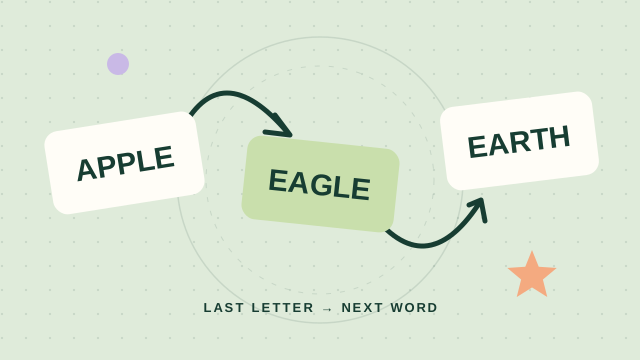
You can also explain a completed word aloud after the reveal: which letters narrowed the possibilities, and which incorrect guess was least supported? That makes a short browser word game into an active language exercise. It is still casual entertainment, not a vocabulary assessment or a promise of improved learning outcomes. If you would rather supply whole words yourself, Word Chain uses the ending of the previous word as the starting point for the next one.
Common questions before your next puzzle
Can I type my own secret word? The current game generates its own puzzles, which keeps the answer unknown to both players. Can I keep guessing after a correct letter? No; turns alternate in this competitive version. Does solving the word guarantee a win? No; the total number of letter occurrences you uncovered determines your score. These distinctions are worth agreeing on before comparing this game with a paper-and-pencil version you already know.
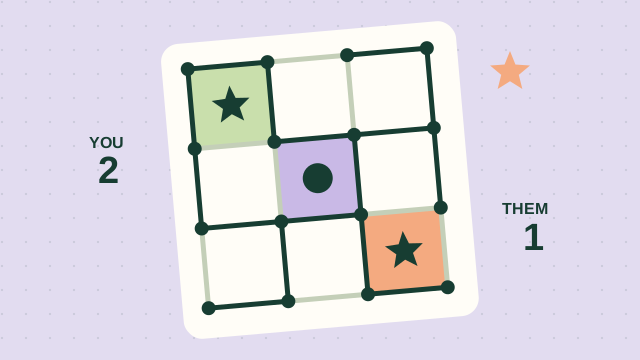
For another quiet thinking game, Dots and Boxes replaces letter patterns with a grid of edges and squares. If you prefer answering a question directly, Trivia Duel offers five multiple-choice prompts. Return to the Hangman board whenever you want another shared mystery: one considered letter can change both the shape of the word and the direction of the match.